
Augmentative and Alternative Communication (AAC) is all the ways a person can communicate besides talking. Augmentative means to add to a person’s speech. Alternative means to be used instead of talking.
Some people use AAC for a short period of time. Some people use AAC throughout their life.
Did you know that everyone uses AAC? Facial expressions, gestures, body language, texting, emails, writing, and social media are just to name a few.
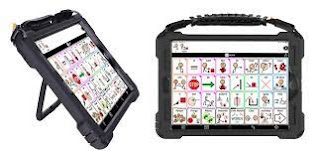
There are many types of AAC systems. Options include no-tech (gestures, eye gaze, body language), low-tech (communication boards, switches, fixed devices, picture exchange), and high-tech (speech-generating devices). Speech-generating devices may include an app on an iPad, tablet, iPhone, or apple watch to communicate. There are many individualized options.
Many people use the Total Communication Approach (all communication methods available to them) by combining no-tech, low-tech, and high-tech options.
Speech-Language Pathologists help find the right AAC system and help people learn how to use AAC to communicate. Occupational Therapists help people access their technology on the AAC system in regards to vision, eye gaze, mounting, and other technologies for access.
Multidisciplinary collaboration important in order to assess the person’s functional skills, preferences, environment, and activities of daily living across different settings.
Common questions about AAC
- Is my child too young for AAC?
No. Research shows that AAC helps people of all ages. You can use AAC early. There are no thinking skills, test scores, or other milestones needed to be reached before AAC can be introduced. Presume competence (believe your child has the potential to use AAC). - Will AAC stop my child from talking?
No. Research shows that AAC improves verbal output. Many children will verbally imitate the AAC device. Robust AAC systems promote reading and writing development as well.